Sally and Ed looked forward to the birth of their first child. Sally's labor was long, so her obstetrician added oxytocin to speed things up. Unfortunately, administration of oxytocin led to unrecognized fetal distress, and their newborn daughter suffered severe brain injury and cerebral palsy.
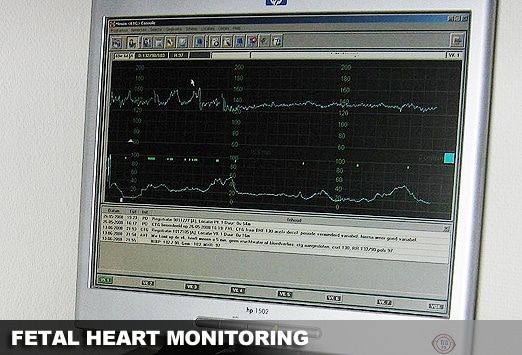
Fetal monitoring to test both uterine contractions and fetal heart rate (FHR) is now the standard of care, with a 30-minute response time from recognition of fetal distress to delivery. The purpose of FHR monitoring is to follow the status of the fetus during labor so that clinicians can intervene if there is evidence of fetal distress, as reflected by an FHR above or below the normal range of 110-160 beats/min or an FHR that does not change in response to uterine contractions.
Electronic fetal monitoring (EFM), also called FHR monitoring, was first developed in the 1960s. Since 1980, the use of EFM has grown dramatically, from being used on 45% of pregnant women in labor to 85% in 2002, according to the American Congress of Obstetricians and Gynecologists (ACOG). "When EFM is used during labor, the nurse or physicians should review it frequently," state ACOG guidelines.
Fetal monitoring to test both uterine contractions and fetal heart rate (FHR) is now the standard of care, with a 30-minute response time from recognition of fetal distress to delivery. The purpose of FHR monitoring is to follow the status of the fetus during labor so that clinicians can intervene if there is evidence of fetal distress, as reflected by an FHR above or below the normal range of 110-160 beats/min or an FHR that does not change in response to uterine contractions.
Electronic fetal monitoring (EFM), also called FHR monitoring, was first developed in the 1960s. Since 1980, the use of EFM has grown dramatically, from being used on 45% of pregnant women in labor to 85% in 2002, according to the American Congress of Obstetricians and Gynecologists (ACOG). "When EFM is used during labor, the nurse or physicians should review it frequently," state ACOG guidelines.
Breast examinations by the physician, teaching of techniques for breast self-examination, and recommendation of mammograms are now the standard of care.
Mammography was developed in the 1950s and became a common diagnostic tool in the 1960s. It is a key method for detecting breast cancer early, when it is easier to treat. In 2005, about 68% of all US women between 40 and 64 years of age had had mammography in the past 2 years, according to insurance studies. All US states except Utah require private health insurance plans and Medicaid to pay for breast cancer screening.

No comments:
Post a Comment